If you read nothing else
This Master of Design thesis presents a participatory co-design study with late-deafened cochlear implant recipients, focused on redesigning the clinical care journey from the perspective of those directly affected. The research demonstrates a comprehensive methodology: 197 applicants were screened, six co-designers were recruited and supported through a multi-phase adapted evidence-informed, experience-based co-design (E2CD) process, and a peer support framework was developed based on lived experience rather than clinical assumptions. This project serves as an example of my approach to research in high-stakes, regulated contexts involving vulnerable populations.
Overview
Cochlear implantation represents a clinical success; however, a significant emotional gap remains unaddressed.
For many adults who experience hearing loss after acquiring spoken language, cochlear implantation improves quality of life and cognitive outcomes from an audiological perspective. However, the decision to undergo permanent, life-altering surgery involves emotional, cultural, and identity-related factors that the current clinical framework does not address. The American Academy of Audiology's clinical practice guidelines organize cochlear implant care into three phases and eight stages, spanning from initial identification to long-term follow-up. While psychosocial support is briefly referenced, the guidelines offer no structured guidance for identifying or addressing emotional needs at any stage of the care journey.
This research, my Master of Design thesis at OCAD University, uses an adapted evidence-informed, experience-based co-design (E2CD) model to collaboratively redesign the patient journey with post-lingual, late-deafened adults who received cochlear implants and whose emotional needs went unmet throughout the process.
Source: American Academy of Audiology Clinical Practice Guidelines, 2019
The Problem
Clinicians designed the care journey primarily to optimize audiological outcomes, not to necessarily address patients' lived experiences.
Audiologists and researchers developed the AAA clinical practice guidelines without direct patient input, resulting in a framework optimized for clinical decision-making. Psychosocial care and referrals are briefly referenced during pre-surgical counseling, but the guidelines offer no structured guidance at any other stage. Audiologists themselves report wanting to support patients' psychological well-being, but cite insufficient training and time as barriers to doing so in practice.
This gap is particularly acute for late-deafened adults. Unlike children — who represent the majority of cochlear implant research — adults are more likely to experience a significant identity shift post-implantation, including the adoption of a disability identity. Adults seeking audiological rehabilitation already report significantly higher rates of depression and anxiety than their hearing counterparts, and the severity of those conditions correlates directly with implant satisfaction. Yet psychosocial counseling remains rarely conducted in clinical settings.
Audiologists want to provide emotional support to their patients; however, the current system lacks structured mechanisms to facilitate it.
The United States healthcare context compounds this. Approximately 60% of states offer Medicaid coverage for adult cochlear implantation, and patients on public insurance are more likely to experience post-implantation complications and less likely to pursue clinician-recommended follow-up rehabilitation — adding further emotional and psychosocial burden to a process already underserved by the standard of care.
"They made it look like cochlear implantation was going to be seamless — no pain. I feel like if they had been more upfront about the painful parts, and had checked in on me emotionally, it might have been better for me."
— Participant 1
"I did not know what to expect emotionally because it was a whole lot going through surgery, thinking things would be fine in a month or two, only to be told you have to do training that takes a long time before you're comfortable."
— Participant 2
Process
The principle of 'nothing about us without us' guided this research, positioning patients as co-designers of their own care.
The research integrates three complementary frameworks: evidence-informed, experience-based co-design (E2CD), community-based participatory research, and Inclusive Design. The through-line across all three is that the people most affected by the gaps in the current care journey are best positioned to identify what a refined journey should look like. Healthcare provider perspectives are represented through prior academic literature and the AAA standard of care, rather than direct participation — a deliberate decision to keep epistemic authority in the patient voice.
Recruitment and screening. A short survey was distributed through closed Facebook and Discord cochlear implant support communities, where the researcher was an active member. 197 respondents qualified after data cleaning. Participants rated perceived satisfaction with emotional support across eight care stages on a Likert scale. Six co-designers were selected for having the highest cumulative dissatisfaction scores — deviating by a mean of 10.62 points above the screener average of 13.86, on a scale of 7–35.
1:1 interviews. Semi-structured interviews were conducted via Microsoft Teams and covered participants' journeys through hearing loss diagnosis, cochlear implant candidacy, insurance navigation, support systems, and relationships with their care team and device. Transcripts were anonymized and analyzed using Braun and Clarke's (2006) six-phase inductive thematic analysis framework.
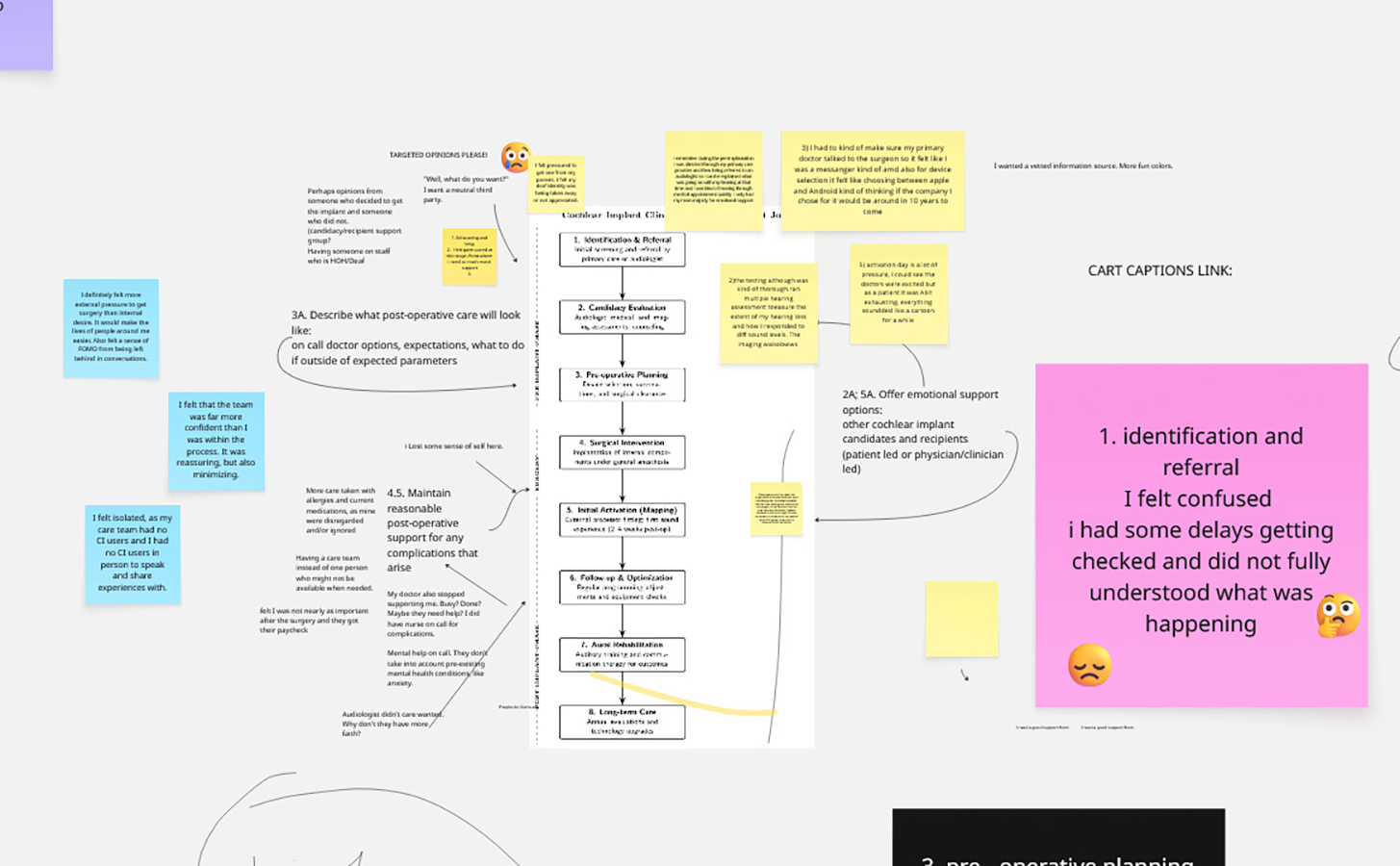
Collaborative journey mapping. Participants attended a participatory workshop via Microsoft Teams, using a shared Miro board as the design artifact. Because all participants and the researcher are cochlear implant recipients, multiple CART captioners were provided throughout. Participants mapped their emotional experiences onto the current AAA care model, revised their annotations through rotational peer discussion, and co-designed solutions in response to the gaps they identified.
Embedded Case Study
Sky — When the System Fails the Patient It Served Best
Sky, 32, entered the cochlear implant journey with the strongest pre-surgical support of any participant. Her surgical team used 3D anatomical models to explain the procedure, proactively connected her with a device representative, and maintained a patient-centered communication style throughout. Her Likert dissatisfaction score was the highest of any co-designer.
This stemmed from a cascading series of preventable clinical failures. Her surgeon closed the surgical site with Steri-Strips despite documented adhesive allergy. The post-operative pain medication prescribed had a potentially fatal interaction with her existing nerve pain medication — caught by the dispensing pharmacist, not the surgical team. She spent six hours unable to reach her surgeon while in significant post-surgical pain. When she sought legal recourse, she found the hospital held retainer agreements with all lawyers in the surrounding area.
"Read the chart. Please, for the love of God, read the f***ing chart. My recovery might have been a lot better if my chart had been read properly."
— Sky
Sky's implant is considered clinically successful based on routine booth testing; however, her overall experience of the care journey was not positive. Her case illustrates that trust established during the initial phase does not necessarily persist throughout subsequent phases, and that the current standard of care lacks mechanisms to identify, escalate, or address harm when it occurs.
Solution
A redesigned journey built for us, by us — with a peer support network as its backbone.
The co-designed revision builds upon the AAA standard of care rather than replacing it. No co-designer argued the clinical stages were incorrectly structured. What they identified, consistently and across all three data sources, was the emotional experience of moving through those stages without adequate support, preparation, or connection to others who understood what they were going through.
The foundational structure of the redesigned journey is a peer support network — the single most consistently requested intervention across all six interview participants and all five workshop co-designers. It takes two forms. A cohort model groups patients implanted within similar time windows to move through the journey together, reducing isolation by creating a shared timeline. A stage-specific peer guide model matches trained recipients with candidates at the stages where their experiences are strongest. Peer guides follow two principles: manufacturer and institutional neutrality, and training in non-directive support that creates space for the candidate's evolving experience rather than projecting the guide's own.
- Vetted co-designed info source
- Peer guide introduction
- Structured emotional check-in
- Psychosocial screening (PHQ-4)
- Peer cohort enrollment
- Patient navigator (insurance)
- Patient-first communication protocol
- Peer-led identity & lifestyle prep
- Mandatory contraindication & allergy checks
- Dedicated, accessible post-surgical on-call team
- Peer guide sets realistic expectations
- Cohort meets around activation date
- Continued check-in & screening
- Continued check-in & screening
- Patient comfort prioritized over booth score
- Realistic roadmap from audiologist
- Institution-hosted cohort meetings
- Accommodation support resources
- Open-door re-entry into peer network
- Vetted, patient-co-created information source (no manufacturer bias)
- Peer guide introduction and opt-in cohort enrollment
- Structured emotional check-ins and routine psychosocial screening (PHQ-4)
- Patient navigator embedded in insurance pre-authorization
- Patient-first clinical communication protocol
- Peer-led identity and lifestyle preparation conversation
- Mandatory contraindicated medication, allergy, and pre-existing condition checks
- Dedicated, easily accessible post-surgical on-call team
- Peer guide sets realistic expectations around activation; cohort meets around activation date
- Continued structured emotional check-ins and psychosocial screening
- Structured, honest rehabilitative roadmap with variable-timeline framing
- Regular institution-hosted peer cohort discussions
- Accommodation support resources (rights, technology, peer role-play)
- Open-door re-entry into the peer support network at any time
"I felt isolated, as my care team had no CI users and I had no CI users in person to speak and share experiences with."
— Participant, journey mapping session
Outcomes
This proposal is grounded in lived experience and serves as a foundation for future developments.
The redesigned journey constitutes a design proposal rather than a tested intervention. Its significance lies in its collaborative development with the individuals it is intended to serve, in contrast to the current standard of care. The research indicates that patients experiencing emotional distress during cochlear implantation represent a minority, yet the AAA framework does not adequately address this minority. By centering lived experience as expertise, this co-design process yields a framework that more accurately reflects the emotional realities of implantation, aligns more closely with patient needs, and offers greater sustainability through its peer-led structure rather than reliance on clinicians.
- 197 screened respondents across implant years 2004–2026; 6 selected as co-designers
- All eight stages of the AAA standard of care revised or augmented with co-designed emotional support structures
- Three primary emotional hotspots identified: candidacy evaluation, initial activation, and aural rehabilitation
- Six consistent themes surfaced across interviews: inadequate emotional preparation, underestimated rehabilitation effort, informal networks filling institutional gaps, desire for peer connection, expectation-reality gap, and identity disorientation
- One embedded case study documenting the fragility of trust across phases, and the cost when that trust breaks down
- A peer support network framework built from scratch, with two structural models and two governing principles
The redesigned journey introduces an emotional access perspective to a process traditionally defined by audiological outcomes, and formally recognizes lived experience as a form of expertise.
Reflections
What this work revealed — and where it needs to go next.
My positionality as a cochlear implant recipient who experienced significant emotional distress throughout the process shaped this research from its inception. This lived experience served as both an asset, facilitating immediate rapport with co-designers, and a limitation, influencing the questions posed and the interpretation of data. Such tension is inherent to insider research, and I have sought to acknowledge it transparently throughout the study.
The online recruitment method, though necessary, primarily attracted participants who were comfortable with technology and community-oriented platforms. This approach may have inadvertently excluded the most socially isolated individuals within this population, who may have the greatest unmet emotional needs. Additionally, the sample is specific to the United States, and the framework may not be directly transferable to countries with more comprehensive publicly funded healthcare systems.
Three critical next steps are required to advance this framework from proposal to practice: incorporating clinician contributions through the full E2CD model; conducting a phased pilot study at an institution with a cochlear implant research center, beginning with the peer support network as the foundational component; and co-designing a structured emotional validation tool for use at clinical check-in points, specifically tailored to cochlear implant candidacy—a tool that is currently lacking.
More broadly, this project highlights an often underappreciated aspect of healthcare design: the primary barrier to emotionally supportive care is not a lack of clinical knowledge, but rather the absence of effective processes. Developing infrastructure that enables consistent emotional support, delivered by multiple individuals without reliance on a single expert, constitutes a distinct design challenge that warrants attention equal to that given to clinical issues.